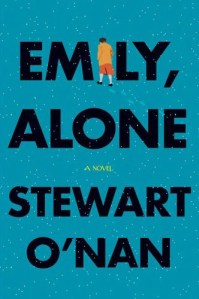
Four more recent reviews of Emily, Alone.
Boston Globe
Drama is in the details
A gentle portrait of a woman in her twilight years — her small everyday victories and setbacks — turns an ordinary life into the extraordinary
What a relief: No vampires, zombies, fashionistas, shopaholics; no child abuse, alternate universes, cyber anything; and no violent crime (only a scratched car door) mark Stewart O’Nan’s lovely, lyrical, leisurely paced portrait of 80-year-old Emily Maxwell. A sequel to O’Nan’s “Wish You Were Here’’ (in which the Maxwell family spends one last week at their soon-to-be-sold summer house), this poignant novel — his 13th — stands on its own. Though, at first, Emily’s world seems measured out in coffee spoons, the quotidian details supply their own drama and beauty, underscoring the small triumphs and losses of daily life: a meal with a discount coupon, a garden, the companionship of an old dog, the comfort of music, a Mother’s Day phone call, a parking space, a cold caught from a grandchild, the noisy construction across the street, a neighbor naked in the moonlight, a friend’s new eyeglasses.
[more]
The Star Tribune
Shouldering on
A woman faces her twilight years alone, but with interest and curiosity.
That’s the book’s goal: To show life’s persistence without the grim fatalism or spry attitude that define so many fictional portraits of the aged. O’Nan’s episodic chapters inhabit Emily’s thoughts on a host of quotidian things: thank-you notes, housekeeping, driving, watching television, listening to the radio. But O’Nan gives each small experience an emotional heft, and he’s supremely skilled at revealing Emily’s emotional investment in every small change in her life. When her dog has to make a trip to the vet, it’s enormous, and when she catches a cold it’s as much opportunity as illness — a chance to interact with others anew. “Being sick,” O’Nan points out, “was news.”
[more]
The Washington Post
‘Emily: Alone’: Stewart O’Nan writes on aging gracefully
“Emily, Alone” is a sequel to “Wish You Were Here” (2002), O’Nan’s long, multi-faceted story about a family’s last summer vacation in Chautauqua, N.Y. It’s tempting to assume that this new novel, at half the first one’s length and with its narrow, sclerotic plot, is just a death rattle from the original story, but in fact it’s better. Shorter, wittier, much more tightly focused, “Emily, Alone” makes the perfect demonstration of O’Nan’s humanizing vision. Yes, there’s always the danger that he’s writing what Frank Norris once disparaged as “the drama of the broken tea cup.” But what saves him is his profound respect for Emily, the hopes and fears that lie beyond her old-lady foibles and fussiness, which, even if you aren’t an old lady and never will be, turn out to be the same hopes and fears we all harbor alone.
[more]
Cleveland Plain-Dealer
Stewart O’Nan finds ‘Emily, Alone’ aging heroically
Reading “Emily, Alone” made me think of Charles Dickens. This is somewhat incongruous, because Stewart O’Nan’s novels are not crafted out of the complicated, multilayered plots that we associate with Dickens. But O’Nan does share a laserlike observational talent with the Victorian master — one that can shock the reader into a sense that the story is lifted out of one’s own family or even oneself.
[more]

Who is Stewart O’Nan? Over the past 17 years, he’s written 11 novels — we’ll turn to the 12th in a moment — as remarkable for their precise, economical language and depth of characterization as for the fact that each is as different from its predecessor, in style, tone and narrative approach, as if it had come from a different author.

 The Joy Of The Mundane In ‘Emily, Alone’