More Emily, Alone Reviews

Huffington Post

Surrounded by Life

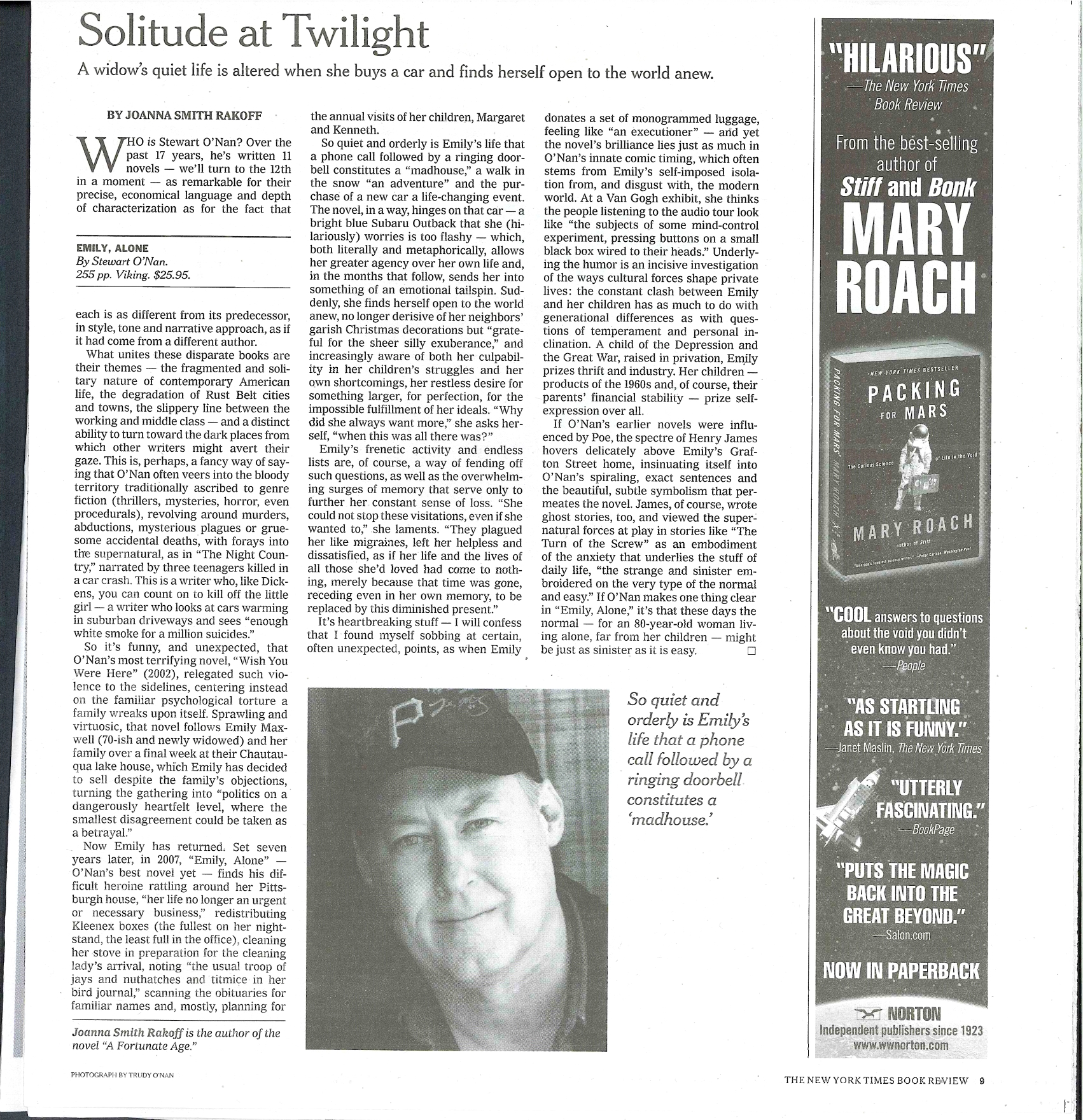
Emily, Alone, by Stewart O’Nan, is a book of quiet yet stunning beauty; steady and trim from the outside, like its protagonist, and, just like her, stirring inside with deep longings, intense observations, and a strong attachment to living. Emily is of the age she claims she never wanted to reach, the very last of her neighborhood’s country club gang of mothers, and living far from her children and grandchildren, who call frequently but not enough, and visit even less often. Emily is tethered to life seemingly only through ties to her sister-in-law Arlene, her own aging dog, and her deep love for her adopted hometown of Pittsburgh. But O’Nan will surprise us, uncovering within his character a capacity for finding so much still to live for — so many ties holding her to people and to places — and providing a reminder to us all of life’s capacity to excite and invigorate, at any age.

[more]

The Caregiver’s Bookshelf (New York Times Blog)

How She Carries On

So often, novels and movies with elderly protagonists take pains to depict them in a state of rebellion. They’re breaking out of an assisted living facility. They’re skydiving and climbing the pyramids, pursuing their bucket lists. They’re heading into space for one last, crucial mission.

They’re behaving, in other words, as if they weren’t old. The preferred word for this state, I believe, is “feisty.”

I cherish the newly published novel “Emily, Alone,” by Stewart O’Nan, because the main character doesn’t deny or resist her age.

[more]

Emily, Alone Review: Fresh Air on NPR

The Joy Of The Mundane In ‘Emily, Alone’
by Maureen Corrigan

It takes a deft hand to do justice to the ordinary. Most novelists don’t even bother to try, which is why most novels are about a rip in the fabric of the routine. It’s tough to find fiction ambitious enough to tackle the story of a run-of-the-mill job, a hum-drum family; but, if the mundane matters to you, then Stewart O’Nan is your man.

[more]
[listen (mp3)]

Emily, Alone Review: The Dallas Morning Post

from The Dallas Morning News:

Book review: ‘Emily, Alone,’ by Stewart O’Nan

By SHAWNA SEED, Special Contributor
Published 25 March 2011 05:38 PM

“Old age is not for sissies,” goes the phrase variously attributed to Bette Davis or Art Linkletter and repeated by countless grandmothers.

Old age hasn’t been much of a place for novelists, either, at least not contemporary ones. That’s part of what makes Stewart O’Nan’s new novel, Emily, Alone, so interesting. His heroine, an 80-year-old widow named Emily Maxwell, is a familiar character — she could be your grandmother or mother or aunt. Her routine is ordinary and her activities mostly mundane: flower shows, funerals and family dinners. But O’Nan’s book, with great poignancy and humor, offers a rare glimpse into the life of a woman whose life is nearing an end.

Emily and her family appeared in an earlier novel, Wish You Were Here, but it’s not necessary to read that book in order to be charmed by this one. She’s an irresistible character — funny, flawed and thoroughly unsentimental about her inevitable fate:

She was dying, yes, fine, they all were, by degrees. If Dr. Sayid expected her to be devastated by the idea, that only showed how young he was.

For all her fatalism, though, Emily’s life isn’t over yet, and one of the novel’s joys is in seeing her world expand.

In the book’s opening pages, Emily’s sister-in-law, Arlene, collapses at a buffet and ends up in the hospital. This is a frightening development for Emily, and inconvenient, too. Emily, who hasn’t driven in years, relies on Arlene for transportation.

Emily gets her mothballed Oldsmobile out of the garage and rediscovers something most people forget after the age of 17, the exhilarating freedom that driving brings.

But Emily’s world is contracting, too. Her Pittsburgh neighborhood is changing in ways she doesn’t like. Her dog is her most constant companion, and Emily’s palpable fear that he will die, leaving her alone, is heartbreaking.

Her friends are dying, too. She and Arlene have been to so many funerals that they’ve become connoisseurs. In a passage that perfectly demonstrates O’Nan’s subtle use of humor, they discuss funeral receptions.

“Remember Gene Hubbard’s?”

“I doubt it will be that lavish.”

“Whoever did his, that’s the kind of reception I want.”

“The cannoli.”

“The cannoli, the crab puffs, the little cheese-and-spinach thingies.”

“Empanadas.”

“And no sandwiches. I don’t want people to have to make their own sandwiches.”

“It’s not a picnic,” Emily said, egging her on.

Perhaps Emily’s greatest sorrow is her strained relationship with her children and grandchildren. They’re irresponsible with money; they don’t call or visit often enough; they don’t write thank-you notes promptly. O’Nan is at his best teasing out the family relationships. Even though the book is told entirely from Emily’s point of view, the reader is able to discern that not all the fault lies with Emily’s relatives.

In different hands, this might have been a morose book, but it’s actually delightful. O’Nan’s ability to deliver such a flawless portrait of a woman 30 years his senior speaks to his gifts as a writer.

A reader does have a sense of foreboding — danger seems to lurk in every snowstorm, bout with the flu or trip down the stairs. It’s no literary device, though. It’s simply a fact of life at Emily’s age, something that she understands and, if not exactly embraces, accepts. Emily Maxwell is no sissy.

Shawna Seed is a writer in Silver Spring, Md.

More Reviews of Emily, Alone

Four more recent reviews of Emily, Alone.

Boston Globe

Drama is in the details

A gentle portrait of a woman in her twilight years — her small everyday victories and setbacks — turns an ordinary life into the extraordinary

What a relief: No vampires, zombies, fashionistas, shopaholics; no child abuse, alternate universes, cyber anything; and no violent crime (only a scratched car door) mark Stewart O’Nan’s lovely, lyrical, leisurely paced portrait of 80-year-old Emily Maxwell. A sequel to O’Nan’s “Wish You Were Here’’ (in which the Maxwell family spends one last week at their soon-to-be-sold summer house), this poignant novel — his 13th — stands on its own. Though, at first, Emily’s world seems measured out in coffee spoons, the quotidian details supply their own drama and beauty, underscoring the small triumphs and losses of daily life: a meal with a discount coupon, a garden, the companionship of an old dog, the comfort of music, a Mother’s Day phone call, a parking space, a cold caught from a grandchild, the noisy construction across the street, a neighbor naked in the moonlight, a friend’s new eyeglasses.

[more]

The Star Tribune

Shouldering on

A woman faces her twilight years alone, but with interest and curiosity.

That’s the book’s goal: To show life’s persistence without the grim fatalism or spry attitude that define so many fictional portraits of the aged. O’Nan’s episodic chapters inhabit Emily’s thoughts on a host of quotidian things: thank-you notes, housekeeping, driving, watching television, listening to the radio. But O’Nan gives each small experience an emotional heft, and he’s supremely skilled at revealing Emily’s emotional investment in every small change in her life. When her dog has to make a trip to the vet, it’s enormous, and when she catches a cold it’s as much opportunity as illness — a chance to interact with others anew. “Being sick,” O’Nan points out, “was news.”

[more]

The Washington Post

‘Emily: Alone’: Stewart O’Nan writes on aging gracefully

“Emily, Alone” is a sequel to “Wish You Were Here” (2002), O’Nan’s long, multi-faceted story about a family’s last summer vacation in Chautauqua, N.Y. It’s tempting to assume that this new novel, at half the first one’s length and with its narrow, sclerotic plot, is just a death rattle from the original story, but in fact it’s better. Shorter, wittier, much more tightly focused, “Emily, Alone” makes the perfect demonstration of O’Nan’s humanizing vision. Yes, there’s always the danger that he’s writing what Frank Norris once disparaged as “the drama of the broken tea cup.” But what saves him is his profound respect for Emily, the hopes and fears that lie beyond her old-lady foibles and fussiness, which, even if you aren’t an old lady and never will be, turn out to be the same hopes and fears we all harbor alone.

[more]

Cleveland Plain-Dealer

Stewart O’Nan finds ‘Emily, Alone’ aging heroically

Reading “Emily, Alone” made me think of Charles Dickens. This is somewhat incongruous, because Stewart O’Nan’s novels are not crafted out of the complicated, multilayered plots that we associate with Dickens. But O’Nan does share a laserlike observational talent with the Victorian master — one that can shock the reader into a sense that the story is lifted out of one’s own family or even oneself.

[more]