Q: What attracted you to the story of F. Scott Fitzgerald in Los Angeles?
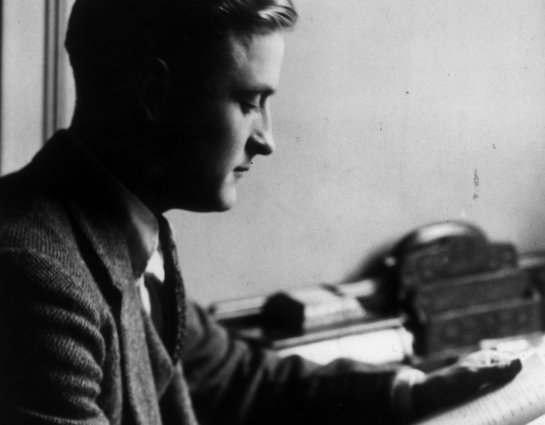
We’ll always be fascinated with Scott and Zelda’s fall from grace from the pinnacle of celebrity and fame. That attracts a lot of writers and readers. But I want to talk about that later story when he gets up off that mat and becomes himself again. I want Scott’s point of view, and you can only do that though fiction.
Q: What is happening to Fitzgerald when the book begins?
It’s 1937. His wife Zelda is in a private asylum in North Carolina, and he realizes that she is not getting better. His daughter is in Connecticut, and he’s deeply in debt to his agent. He has no other prospects, and he has no choice but to try screenwriting for the third time.
[more]
Tag Archives: west of sunset
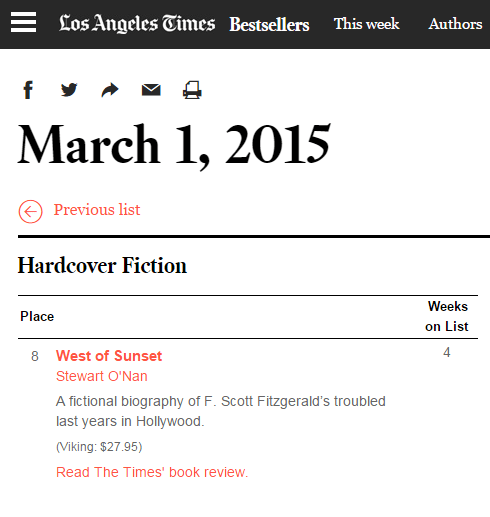
West of Sunset at #8 on the L.A. Times Bestseller List; 3/11 6pm Event at Point Park University

On Wednesday, March 11 at 6pm, Stewart will be giving a public reading at Point Park University. Read all about it:
BESTSELLING NOVELIST STEWART O’NAN TO LEAD MASTER CLASS AT POINT PARK
Stewart O’Nan is the latest award-winning author to be a part of the Point Park University Writers’ Series. He will teach a master class exclusively for Point Park students March 11, 2015, and then will lead a public reading at 6 p.m. in Lawrence Hall 200.
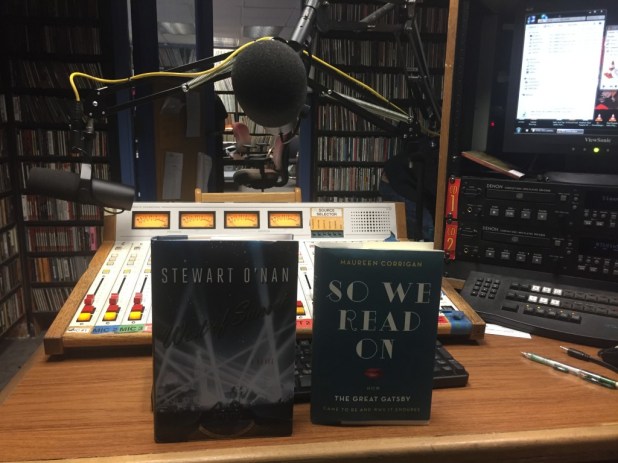
Maureen Corrigan and Stewart O’Nan on Writers on Writing

Maureen Corrigan, author and NPR book critic, talks to co-host Nicole Nelson about her latest book, So We Read On: How The Great Gatsby Came To Be And Why It Endures, as well as what some of Fitzgerald’s revisions left behind in earlier drafts of the novel, the importance of water imagery in the book, and her experience retracing some of the author’s steps. In the second half, Stewart O’Nan discusses his latest novel West of Sunset, which fictionalizes the last chapter of Fitzgerald’s life, the Hollywood years. He talks about coming late to appreciate Fitzgerald himself, what kind of research was required to immerse himself in the world of Hollywood in the late 1930s, and how his experience writing narrative nonfiction helped create a world that served both history and his character. (Broadcast date: February 25, 2015)
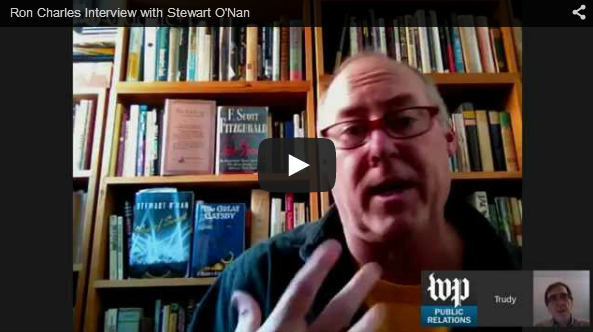
Washington Post Video: Book World Editor Ron Charles speaks with bestselling author Stewart O’Nan
The Washington Post Book Club presents an exclusive interview with author Stewart O’Nan as he discusses his latest novel and Book Club fiction pick for February, “West of Sunset” with Book World Editor Ron Charles. Leading up to the interview, Book Club members had the opportunity to submit questions to O’Nan about “West of Sunset” and some are addressed in the conversation.
Learn more about The Washington Post Book Club and join the conversation surrounding monthly picks in fiction and nonfiction online.
Read the review of Stewart O’Nan’s “West of Sunset” in Book World.
Two More Reviews of West of Sunset

From The New York Times Book Review:
It’s Zelda Fitzgerald, whose mental breakdowns had taken her to an asylum in Asheville, N.C., who gives the novel depth and poignancy. The book begins with Fitzgerald visiting her on their 17th wedding anniversary, just before heading west. The woman he sees, in her late 30s, is hard to recognize as the Zelda of legend. She is “pinched and haggard, cronelike, her smile ruined by a broken tooth.” After moving to Hollywood, he pays several visits back East, each time noticing how Zelda has changed: She has gained weight, her hair has been dyed an unflattering brown, her frumpy clothes are hospital donations. He monitors her for signs. Is she stable or is she once again seeing the Archangel Michael? They pretend to each other and to themselves that they might actually live together again. O’Nan is most convincing when he conveys the heartbreaking guilt Fitzgerald feels about having left Zelda behind in so many ways.
From Tuscaloosa News:
‘West of Sunset’ is a Fitzgerald tale
Sophisticated, witty remarks and entertaining anecdotes are always welcome, but O’Nan’s real achievement in “West of Sunset” is not the story, exactly. O’Nan gives us, convincingly, Fitzgerald’s state of mind: his remorse over past foolishness, his determination to succeed at screenwriting, even though it did not come naturally to him, his desperate need to redeem himself as a fiction writer and to create for his life, in the theatrical sense, one more act.We see him absorbing, day after day, the feel, color, mood of studio life, the telling details for the Hollywood novel which was to launch his comeback. “The Last Tycoon” had as protagonist the bold, innovative producer Irving Thalberg, who had died in 1936 at 37 years old and whom Fitzgerald admired hugely.
If he could just get it finished, Scott believed, “The Last Tycoon” would be his masterpiece.
It would have been, too!
[more]