A pair of publicity shots from the Jimmy Fund event. Click to enlarge the thumbnails.
Photo credit: Christina Gordon

A pair of publicity shots from the Jimmy Fund event. Click to enlarge the thumbnails.


Photo credit: Christina Gordon
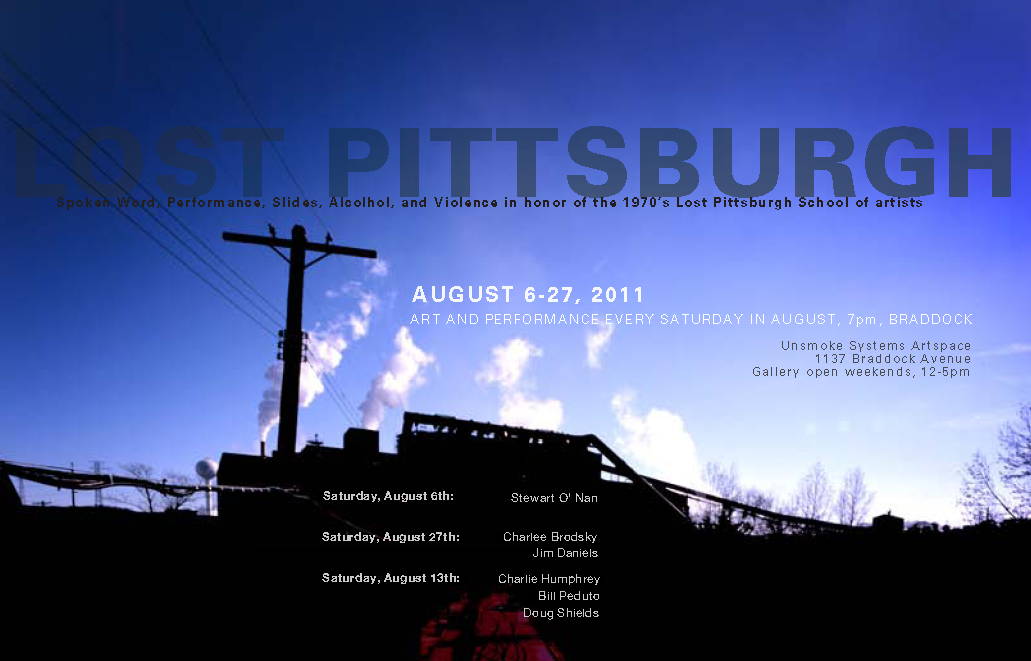
Saturday, August 6, 7pm at Unsmoke Artspace, Braddock, PA
 If you listen to NPR’s Fresh Air tomorrow, you’ll hear Terry Gross interview Stewart O’Nan. This post will be updated with the online link once the audio becomes available.
Update: from NPR Fresh Air – What It’s Like To Be An Elderly Widow, All ‘Alone’
The Globe and Mail (Toronto)
She’s not about to go gentle into any dark night
Emily, Alone is one of those rare books in which nothing particular happens and yet just about everything seems to be going on. Stewart O’Nan’s 12th novel is a sequel of sorts to his well-regarded Wish You Were Here (2002), which dealt with the white, middle-class Maxwell clan as it tried to come to terms with the recent death of their patriarch, Henry. A decade later, Henry’s widow Emily soldiers on, surviving in quiet suburban solitude in the too-big Pittsburgh home she refuses to vacate. Her life is a progression of difficult negotiations with both the past and an outside world which is leaving her further and further behind. Should she sell Henry’s monstrous old Oldsmobile for a more practical car? What is to be done about her sister-in-law Arlene’s smoking, which is clearly killing the woman? Should she put down the family dog as he grows increasingly decrepit?
[more]
Macleans (Canada)
This exquisite novel plumbs an interior landscape rarely explored in literature—that of a sharp 80-year-old American woman watching the contours of her quiet life grow ever narrower. Emily Maxwell, introduced in O’Nan’s Wish You Were Here (2003), is a compellingly old-fashioned character—wry, unsentimental, resourceful, self-critical and stalwart, even as her life fills with loss. Her beloved husband and best friend are dead, her family is far-flung, and her once-tight circle of country-club friends diminishes by the week. The brutalities of old age are upon her: she’s socially invisible, her body is weakening, she’s nervous in her once-genteel Pittsburgh neighbourhood.
[more]
The elderly widow, soldiering on alone after her husband’s death, long after her children have grown and moved away, may not be the stuff of high drama, but it contains a mother lode (so to speak) of rich material. And why not? Who better to delve into issues of mortality and values than those nearing the end who, ironically, have plenty of time on their hands for deep reflection? These women maintain rich inner lives even as their worlds contract.
Often, as in Clyde Edgerton’s hilarious Walking Across Egypt (1987) — a personal favorite — plots turn on an unexpected connection between a dowager and a troubled youngster. But in Stewart O’Nan’s Emily, Alone, a welcome follow-up to his 2002 novel, Wish You Were Here, the emphasis, as the title suggests, is Emily, toute seule, determined to uphold standards and maintain discipline even as her world erodes.
[more]
 On April 30, Stewart participated in an online chat for The Nervous Breakdown’s book club:
Brad Listi (BL): Three minutes, ladies and gentlemen.
Stewart O’Nan (SO): Gotta warm up my Magic 8-ball.
BL: (He’s not referring to cocaine, ladies and gentlemen.)
SO: I was gonna say — not a Belushi reference.
[THREE MINUTES ELAPSE.]
BL: Okay…I believe we’ve reached the top of the hour. Let’s get started. I want to begin by thanking Stewart O’Nan for taking the time to be here this evening. It’s a thrill to have you, Stewart, and congrats on Emily, Alone.
SO: Thanks for having me and Emily (and Rufus).
BL: In this book, you’re writing an older female protagonist. The level of detail you’re able to deliver about that experience is pretty striking. I’m curious if you did any research here, or if you’re simply working from life experience and imagination.
SO: I did a fair amount of research. Handed out questionnaires to older folks at my library readings. And kept several notebooks to get closer to Emily and her world in Pittsburgh.
BL: Can you describe these questionnaires?
SO: I’d ask people how their neighborhoods had changed, and if there were neighbors who were no longer there whom they missed. I asked for three places they went to every week, who they wished they saw more in their lives, what’s become harder the older they’ve gotten.
BL: You tend to write about people “unlike” yourself, to work “from the outside, in,” as opposed to the other way around. Do you feel this is a fair assessment?
SO: Maybe. I mean, I think I share the emotional worlds of my characters even if I’m not like them in age, gender, race, class, or even region sometimes. I like to find out how it feels to be someone else, what they go through, what’s important to them — and I think that that is usually the same. We want to be understood by the people closest to us.
[more]

