Emily, Alone: Reading Group Guide and Author Q&A

A CONVERSATION WITH STEWART O’NAN

Q. At first glance, you wouldn’t seem to have all that much in common with Emily Maxwell, the widow in her late seventies who is the main character of Emily, Alone. How does a novelist go about thinking his way into the experiences and consciousness of someone so different from himself?

I share a great deal with Emily, in that, having previously written a six hundred-page novel about her and her family, I know the people closest to her extremely well. I also know her neighbors intimately, and her social circle, the little town she comes from, her parents, her sorority sisters, her old roommate Jocelyn. Much of it comes from my own family life, and much from just keeping my eyes open and taking notes, but some also comes from active research, location scouting, extensive interviews with people Emily’s age and in Emily’s situation. It all goes in, but finally it has to be strained through Emily’s sensibility, Emily’s feel for life, and that can only be felt or sensed. What, naturally, would Emily see, and what language would she use to describe it?

Q. Did you have a particular model or models for Emily?

When I did research for The Circus Fire, I did hundreds of interviews with survivors, most of whom were in their seventies and eighties. And when they invited me into their homes, they told me their stories not just about the fire but about their whole lives. That experience of looking back on life and appreciating where you are and how you got there comes from those survivors. In terms of personality, Emily shares much with my mother, my mother-in-law, my grandmothers, and my wife’s grandmother.
[read more]

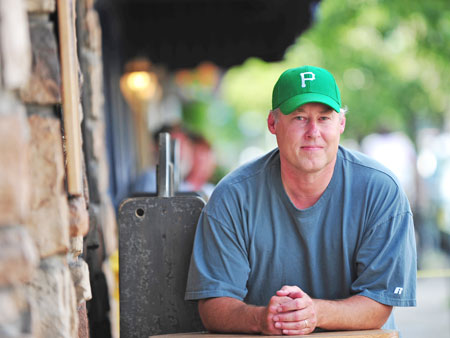
Writer Stewart O’Nan took roundabout route to successful writing career

From the Pittsburgh Tribune-Review:

Writer Stewart O’Nan is sitting at D’s SixPax and Dogz in Regent Square, talking about his life, his work and returning to Pittsburgh last year after a 30-year absence.

He talks about his family — his father, an engineer; his mother, a schoolteacher — and how they set examples for him, and of his wife, Trudy, a Butler native and social worker, who convinced him to quit his career as an aerospace engineer to study writing. He speaks of the proverbial Pittsburgh work ethic and how that has stood him well in all of his endeavors.

Then the conversation turns to former jobs.

“I was a dishwasher,” he says. “Every time I do a dish, a record falls. … I never got to be waitstaff, I never got to be a busboy. I was always a dishwasher, and that’s where you get to hear the best stories.”

Small wonder then that O’Nan, 49, is one of the best storytellers in contemporary fiction. His novels and stories often spotlight characters who are ignored by the mainstream, though they often are in plain sight.

[more]

Authorlink Interview

From “Internationally Acclaimed Author O’Nan Hunts for the “Emotional Center” of a Story”:

AUTHORLINK: How long have you been writing?

O’NAN: 25 years. It’s my silver anniversary!

AUTHORLINK: You work in so many areas – fiction, nonfiction, essays, criticism – what can you tell new authors who feel they must specialize to succeed?

O’NAN: Just write the book you want to read. Your taste in reading should be your guide. If you love to read one genre above all others, then maybe you’ll specialize in that one. But if you love to read all different kinds of books, it’s only natural that you’ll write them too.

[read more]